ROUPELA CENTURY OF HISTORY AND FORTIFICATIONS
From the first fortifications of 1914 and the events of the National Schism to the construction of the Metaxas Line and the legendary Battle of the Forts in April 1941, Roupel holds a special place in modern Greek history.
The strategic importance of the Roupel Gorge, between the Kerkini (Belles) and Agkistro mountain ranges, shaped Greece’s defensive planning for decades. Two different generations of fortifications were built in the same area, associated with two world wars and some of the most critical moments in Greek history.
1914–1916The first blocking forts
After the Balkan Wars of 1912–1913 and the incorporation of Macedonia into Greece, fortifying the country’s new northern borders became an immediate military priority. Bulgaria had not accepted the territorial settlement established by the Treaty of Bucharest in August 1913, and the possibility of another conflict remained real.
However, the country’s limited financial resources did not permit a single, extensive defensive system. Instead, individual blocking forts were built at the most important passes along the Greek–Bulgarian border, which in 1914 extended approximately 222 kilometres.
The forts were intended to delay a potential enemy invasion by resisting for several days until Greek army reinforcements could reach the area.
Following a proposal by Ioannis Metaxas, then a lieutenant colonel of Engineers and director of the Second Staff Directorate, eight blocking forts were built between 1914 and 1916, from Lake Doirani in the west to the River Nestos in the east.
These were Dova Tepe near Kastanousa, Roupel, Krousovitiko near Faea Petra, Startsitsa at Perithori, Lisse at present-day Ochyro, Touloumbar, Boukia at Paranesti and Intzes at Paradeisos. The city of Kavala was also fortified as a second defensive position.
The forts were designed as enclosed, semi-permanent fortifications, with artillery as their main defensive weapon. The infantry played a mainly supporting role, protecting the guns at close quarters and defending the perimeter.
Each fort had gun positions, personnel shelters, artillery and infantry observation posts, ammunition and food stores, dressing stations and auxiliary facilities. Trenches linked the individual works, while barbed wire and an infantry fighting line protected the perimeter.
The initial plan envisaged supplementing the forts with smaller defensive works that would exploit natural obstacles and make them harder to outflank. Insufficient funding, however, limited these plans, and many supplementary works were replaced by simple field fortifications.
Three forts from this period were built in today’s Serres Regional Unit: Dova Tepe, Roupel and Krousovitiko (Faea Petra).
The first Roupel Fort and the strategic importance of the Gorge
The first Roupel Fort was built on the south-western slopes of Mount Agkistro, also known as Tsigeli, to control one of the area’s most important natural passages.
The Roupel Gorge, approximately 11 kilometres long, follows the course of the River Strymon between the Kerkini (Belles) and Agkistro ranges. It forms the natural gateway connecting the area around Petrich in Bulgaria with the Serres plain and, through it, the Greek interior.
Its importance was already recognised in Byzantine times, when the area was known as Roupelion. Its geographical position repeatedly made it a site of military operations and conflict.
The principal task of the 1914 fort was to use its artillery to prevent enemy forces passing through the Gorge and advancing towards Serres and Thessaloniki.
The fortification had lightly protected shelters for its garrison and supplies. Its defensive perimeter extended approximately 2–3 kilometres to protect the artillery positions, while provision was made for 50 infantry machine guns.
The discovery of a Bulgarian military map from 1933 showing Roupel’s 1914–1916 fortifications is particularly significant. Comparing the historic map with the terrain today reveals the extent of the original defensive complex and provides valuable evidence of its history.
1916The surrender of Roupel and the National Schism
The First World War broke out in the summer of 1914, following the assassination of Archduke Franz Ferdinand in Sarajevo and Austria-Hungary’s declaration of war on Serbia on 28 July 1914.
Greece initially chose neutrality, but the spread of military operations into the Balkans and the confrontation between King Constantine and Eleftherios Venizelos drew the country into the turmoil of the National Schism.
In October 1915, Bulgaria entered the war alongside the Central Powers, attacking Serbia. Meanwhile, British and French Entente forces landed at Thessaloniki, laying the foundations for the Macedonian Front.
The Allied presence in Macedonia and their advance towards positions on the Greek–Bulgarian border increased tensions. The occupation of strategic points, including Dova Tepe Fort near Kastanousa, prompted a response from the Central Powers.
Germany informed the Greek government that German–Bulgarian forces intended to enter Greek territory on both sides of the Strymon to a depth of approximately 14 kilometres.
The German–Bulgarian advance towards Roupel began on 13 May 1916.
At 09:45, when a German column crossed the border near Promachonas, the alarm was raised at the fort. Its commander, Major Ioannis Mavroudis, ordered his men to open fire, temporarily halting the enemy advance.
Greek forces were also mobilised in the sector of the Fourth Division, to which Roupel belonged, with a total strength of approximately 25,000 men.
At 15:00, however, an order arrived from Athens that changed the course of events. The Greek government ordered that no resistance be offered and that the fort be surrendered, accompanied by a strong diplomatic protest.
Negotiations took place between Mavroudis and the German cavalry captain Thiel. They agreed to evacuate the fort by 09:00 the following morning, and signed a surrender protocol covering the installations and military equipment left behind.
The Greek garrison left Roupel and marched towards Sidirokastro.
The surrender of Roupel became one of the most controversial episodes of the National Schism, provoking fierce political reactions and deepening the divide between the opposing sides.
Athens lodged strong diplomatic protests with Berlin, Vienna and Sofia, but the occupation of the fort proved to be only the beginning.
In August 1916, German–Bulgarian operations spread into Eastern Macedonia. At Krousovitiko Fort near Faea Petra, the Greek garrison under Georgios Kondylis resisted and subsequently managed to escape towards Kavala.
Fighting also occurred around Sidirokastro without stopping the invaders’ advance. By the end of August, German–Bulgarian forces had also occupied Serres.
The Bulgarian occupation of Eastern Macedonia continued until the end of the First World War in 1918, leaving deep scars on the local population.
Greece officially entered the war on the Entente side in 1917, after Eleftherios Venizelos prevailed and King Constantine was removed.
1936–1940Construction of the new Roupel Fort
Two decades later, Greece began building a new and much stronger system of fortifications along the Greek–Bulgarian border, known as the Metaxas Line.
The new Roupel Fort was built between 1936 and 1940, in the same general area as the fortifications of 1914–1916.
Despite enormous differences in construction and defensive capability, its basic mission remained unchanged: to repel an enemy attack in the Roupel Gorge and prevent an advance into the Greek interior.
The new complex was designed around the terrain of Mount Agkistro, making use of the steep slopes, ravines and natural obstacles.
Seven large sealed complexes were built: Ousita, the Entrance Complex, Molon Lave, Profitis Ilias, the Exit Complex, the Rear Defence and the Command Post. Nine separate machine-gun positions completed the defensive system.
The installations occupied different elevations, from the banks of the Strymon to the higher positions on Agkistro, providing mutually supporting control of the Gorge and the surrounding mountain passes.
The lowest complex was Ousita, close to the Strymon, while the Command Post, containing the tunnel open to visitors today, was built higher up.
Roupel’s underground communication tunnels and shelters reached a total length of approximately 6,100 metres, with 123 combat emplacements.
These included machine-gun positions, anti-tank and anti-aircraft gun positions, mortar and grenade-launcher positions, observation posts and other combat facilities.
The fort’s armament comprised seven 75.7 mm guns, five 35.1 mm anti-tank guns, one 37.3 mm anti-aircraft gun, three 20 mm anti-aircraft guns, twelve 81 mm mortars and 76 grenade launchers, as well as the garrison’s individual weapons.
When completed, Roupel was one of the largest and strongest fortified complexes on the Metaxas Line.
1941The German invasion and the stand of the forts
In November 1940, while the Greek army was fighting the Italians in the mountains of Northern Epirus, the German leadership began planning Operation Marita for military intervention in the Balkans.
The failure of the Italian invasion of Greece had damaged Axis prestige, while Adolf Hitler sought to secure south-eastern Europe ahead of the planned attack on the Soviet Union.
After Bulgaria joined the Axis on 1 March 1941, German forces entered Bulgarian territory and began concentrating opposite the Greek border.
The German Twelfth Army, commanded by Field Marshal Wilhelm von List, was responsible for operations in the Balkans. A principal objective was to break through the Greek defences in the Roupel Gorge and capture the Strymon railway bridge, opening the route towards Sidirokastro and Serres.
The attack on Roupel was assigned to the battle-hardened 125th Infantry Regiment, which had taken part in operations against the Maginot Line in France in 1940. German forces were reinforced by a detachment of the 100th Mountain Regiment, engineer units, artillery and mortars.
Air support was also substantial. Of the 576 German aircraft reported as available for the Twelfth Army’s Balkan operations, approximately 250 are estimated to have been used in attacks on the Roupel and Belles forts.
On the Greek side, the Sidirokastro Group, headquartered in Sidirokastro, was responsible for defending the area east of the Strymon as far as the region north of Ano Vrontou.
Roupel belonged to the Group’s Western Subsector, together with Karatas Fort and the intervening area.
Roupel was commanded by Infantry Lieutenant Colonel Georgios Douratsos. At the start of operations, its garrison reportedly comprised 27 officers and 950 other ranks.
The batteries of Captain Kozonis and Lieutenant Kyriakidis reinforced the defence, with eight guns in carefully selected, well-concealed positions.
Facing stronger German forces, Roupel’s defenders prepared for a battle in which the mountainous terrain, the strength of the fortifications and the garrison’s determination would prove decisive.
Sunday 6 April 1941The first German attack
The German attack on the Metaxas Line began at 05:15 on Sunday 6 April 1941.
Roupel came under heavy artillery fire of various calibres, followed by air attacks from 06:00. German Stuka dive bombers attacked in formations, spreading terror with their sirens before releasing their bombs.
German attacks targeted not only Roupel but also the neighbouring forts of Paliouriones, Karatas and Kali, and the Kapina Resistance Centre.
The German command sought to neutralise the Greek positions and force open the Gorge so its troops could advance into the country’s interior.
One of the first operations took place on the River Strymon. A specialist German company attempted to cross the river in 18 inflatable boats.
The operation failed. The boats became caught in barbed wire laid in the water, while the Germans came under crossfire from the Greek positions at Ousita and Paliouriones. Casualties were extremely heavy, and only a few soldiers escaped by swimming.
At the same time, the First Battalion of the 125th Infantry Regiment crossed the Bistritsa River and deployed along a broad front. One company advanced along the Gorge, but came under devastating fire below Ousita and was pinned down.
The other companies of the battalion met a similar fate. Despite repeated attempts, the Germans failed to break through Ousita’s defences and, at sunset, withdrew towards the heights east of Promachonas.
In the sector further east, the Germans initially surprised a Greek covering platoon and captured the Bistritsa bridge intact. Greek artillery fire subsequently destroyed it.
The German Second Battalion captured Hill 354, known as Chalasmata, and prepared for further infiltration, while the Third Battalion attacked towards the Neoi and Anatolikoi Profites heights.
The attacks were repelled with heavy losses for the invaders, who were forced onto the defensive.
Nevertheless, the first day brought dangerous developments. Exploiting the deep ravines between Roupel and Karatas, German forces penetrated further south and captured Kleidi village and Tsouka Hill.
This infiltration posed a serious threat to the rear of the Greek defences.
Meanwhile, German activity against Karatas and Kali consisted mainly of artillery and air bombardments, while the attack on Paliouriones was also repelled.
The first day of the Battle of Roupel ended without a German frontal breakthrough of the fort’s defences.
Monday 7 April 1941The battle for the heights
From the early hours of 7 April, German forces renewed their attacks on the forts, supported by artillery and aircraft.
Meanwhile, the German command pursued its plan to outflank the Metaxas Line through the Strumica River valley, seeking passages that would allow an advance into the Greek interior.
At Roupel, commander Georgios Douratsos ordered three patrols to clear German detachments from the area and restore telephone communications between defensive positions.
Despite continuous bombardment, the Greek patrols captured 14 German soldiers, together with three radio sets and two mortars.
The presence of German troops south of Roupel, around Kleidi and the neighbouring heights, was particularly alarming.
The Greek command organised a counterattack to deal with the threat. The tank platoon intended to take part could not be used because of the difficult terrain.
Greek troops, including platoons under Nianos and Papachatzis, with Second Lieutenant Karatzas also participating, advanced against the Germans occupying the Seventh Battery’s observation post on Tsouka Hill.
A day-long battle followed. The Greek forces eventually drove the Germans back towards Goliama Hill, between Kleidi and the hill of Loutra Sidirokastrou.
The counterattack’s success and the relatively limited Greek losses significantly boosted the defenders’ morale.
Papakonstantinou’s diary offers a telling account:
“The soldiers’ morale was magnificent. They greeted the bombardments and the inferno of fire with cheers.”
That same evening, however, a development occurred that would decisively affect the campaign. The German Second Panzer Division had reached the Greek–Yugoslav border near Lake Doirani, threatening to outflank the Greek fortifications from the west.
Tuesday 8 April 1941The pressure intensifies
At 06:00 on 8 April, Roupel and Paliouriones came under another heavy bombardment by German aircraft and artillery.
The attacks continued throughout the day as the Germans attempted to break the resistance of the Greek garrisons.
The Third Battalion of the 125th Infantry Regiment prepared a fresh attack with three ground groups and a pioneer platoon. It was reinforced for this purpose by two additional platoons from the Thirteenth and Fourteenth Companies.
The Germans attempted to approach the Greek positions and neutralise the defensive works using specialist engineer detachments.
Meanwhile, the situation south of Roupel grew increasingly difficult. The Second Battalion of the 125th Regiment was reinforced by troops of the German Fifth Mountain Division, which had advanced west of the Strymon.
Greek defences came under further pressure when the battalions of the 41st Infantry Regiment were ordered back to their original battle positions.
The possibility of German troops crossing the Strymon created a serious danger of the forts being surrounded.
Despite the worsening situation behind the lines, Roupel continued to resist, and the attackers had still not captured the defensive complex.
Wednesday 9 April 1941“Forts do not surrender”
The fourth day of battle began with further bombardments and attacks on Roupel and Paliouriones.
After midday, German fire intensified. The defenders replied from their artillery and machine-gun positions, inflicting heavy losses and forcing enemy units to retreat.
The overall military situation, however, had now been transformed.
German armoured forces had bypassed the Metaxas Line through Yugoslavia and entered Thessaloniki. On 9 April 1941, the Eastern Macedonia Army Section (TSAM) signed its capitulation.
The forts still resisting faced a new reality. Their fight continued, but the Greek military command in Eastern Macedonia had surrendered.
At 17:00, German envoys arrived at Roupel, informed the commander of the capitulation and demanded the fort’s surrender.
Lieutenant Colonel Georgios Douratsos refused to surrender Roupel without orders from his superiors.
His stance is captured in the historic response attributed to him and associated with the Battle of the Forts:
“Forts do not surrender; they are taken.”
In the formal wording of the reply quoted in historical accounts, the commander made clear that the garrison had received no order for an armistice or surrender and would continue resisting.
“Forts surrender only when they are captured by the enemy. We have received no such orders concerning an armistice or otherwise from our higher authorities.”
“We receive and execute only orders originating from our superior authorities.”
“The fight will continue. Any attempt to approach the fort will be crushed.”
The German envoy gave his word as an officer that the news of the capitulation was true. A further meeting was agreed for 06:00 the next morning.
In the meantime, Roupel contacted its higher military command and confirmed what had happened.
News of the capitulation deeply moved the garrison. After four days of fierce fighting, the fort’s defenders learned that their struggle must end, although German forces had failed to capture Roupel in a frontal assault.
Thursday 10 April 1941The garrison’s departure
At 06:00 on 10 April, Roupel’s commander Georgios Douratsos met the German colonel assigned to take over the fort.
The Greek commander set a clear condition: no German soldier was to enter the fort until the last Greek defender had left.
The condition was accepted.
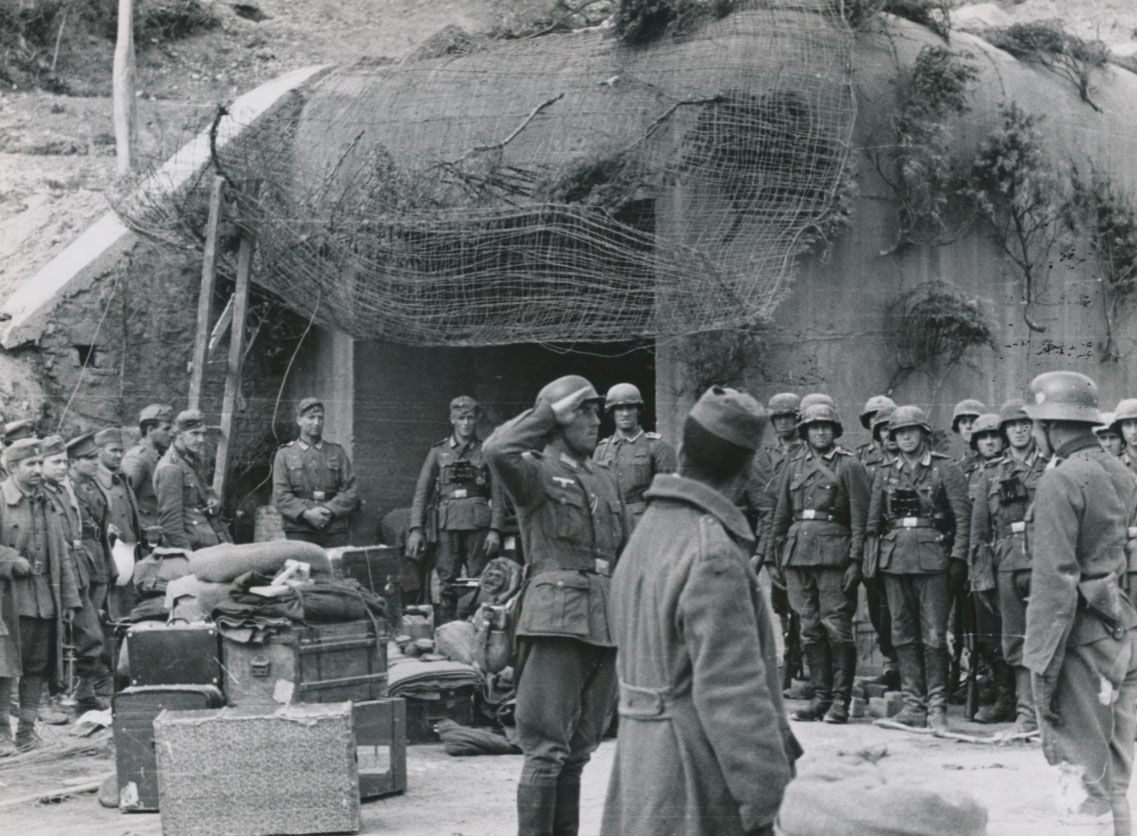
Roupel’s resistance had earned its opponents’ respect. According to historical accounts, the German officer congratulated Douratsos and expressed admiration for the Greek soldiers’ courage, stating that facing such a brave opponent was an honour for the German army.
A German military detachment had assembled outside the fort and rendered honours to the Greek defenders.
Roupel’s officers and soldiers then left their positions and marched towards Sidirokastro and Serres.
Roupel had not been taken by assault. Its garrison ceased fighting after the capitulation of the Greek military command in Eastern Macedonia.
Thus ended the four-day Battle of Roupel, one of the defining episodes of Greek resistance during the German invasion of April 1941.
Casualties in the Battle of Roupel
The Greek forces’ resistance came at a heavy human cost.
According to the figures given for the battle, the garrison of Roupel Fort suffered 14 dead and 38 wounded.
In the wider operational area, including Roupel, Kapina, Karatas and Loutra Sidirokastrou, Greek losses from 6 to 10 April 1941 amounted to 122 dead, including nine officers.
These casualties reflect the intensity of the fighting, not only within the forts’ main installations but also on the surrounding heights, in the ravines and at the external defensive positions.
The Battle of Roupel was not confined to underground tunnels and machine-gun positions. It unfolded across an extensive mountainous battlefield, where small Greek detachments faced strong German forces, attempting to prevent the fortified complexes being outflanked and surrounded.
RoupelFrom 1914 to the present
Roupel’s history extends beyond April 1941. It begins with the need to protect Greece’s new borders after the Balkan Wars and is directly linked to two world wars, the National Schism and the major political and military upheavals that shaped Greece in the first half of the twentieth century.
In 1916, the first Roupel Fort was surrendered to German and Bulgarian forces on the Greek government’s orders, before its garrison’s capacity for resistance had been exhausted. In 1941, the new fort resisted German attacks for four days, and its garrison withdrew only after the Greek military command capitulated.
Two different historical moments in the same strategic location reveal the particular circumstances and dilemmas of each era.
Today, Roupel Fort is one of Greece’s most important places of historical remembrance. Its underground tunnels, machine-gun positions, observation posts and other defensive works keep alive the history of those called upon to defend the Gorge.
Research into the fortifications of 1914–1916, together with historical maps and archival evidence, also illuminates a less familiar chapter of Roupel’s history and highlights the continuity of the military presence in the area.
From the blocking fort of 1914 to the stand of April 1941, Roupel remains a living monument to modern Greek history, military architecture and human sacrifice.